Let’s begin with the date, December 25. But first, I want to highlight the name “Satan.” If we examine this term, what do we find? The Bible mentions Satan numerous times, describing him as a serpent, an enemy of God, a powerful and malevolent entity influencing souls, the leader of evil spirits and demonic forces, the father of lies, and the father of confusion, among other titles. Essentially, the Bible portrays him as evil. If you look up Satan in sources like Britannica, it describes him as “the prince of evil spirits and adversary of God.” So, regardless of where you look, the consensus is that he is evil.
Now, what does “Satan” spell backwards? “Satan” backwards is “Natas.”
Strongs concordance has meanings like: forsake, fall, cast off, loosed, lie, etc..
Mylofamily.com says: A person born on Christmas day; gender: boy; origin: Latin.
Babynames.mom.com says: Lithuanian: Natas/Natalis is a male equivalent of Natasha/Natalia, from the the Latin natale domini, “birthday of god,” i.e. Christmas
Origin: From root name Natalia. From the Latin Natalia, a name derived from diēs nātālis (natal day, Christmas), which was originally given to children born on Christmas Day.
Gvsu.edu Occult Criminal Investigation says: Natas is used as symbols for satanic worship and mockery against God
Now lets go back to December 25th, who was born on this day (Christmas)?
It’s been claimed that numerous pagan gods share a birthday on December 25, including Horus, Osiris, Attis of Phrygia, Krishna, Zoroaster, Mithra of Persia, Heracles, Dionysus, Tammuz, Adonis, Hermes, and Prometheus. However, many argue that most of these gods either don’t exist in historical records or there isn’t solid evidence confirming their birthdays on December 25. Some even suggest that only Tammuz, Mithra, and Dionysus have celebrations around this date.
Who was Tammuz?
The author of “The Two Babylons” identifies also the child, whose birth was so universally celebrated, with Nimrod, who built the tower of Babel, and says that he was worshiped by the name Osiris in Egypt, and Tammuz (the same one as Adonis the famous hunter) in Phoenicia and Assyria. (See page 56.) This Tammuz is also mentioned by the holy prophet, Ezekiel, who in a vision saw the women of Judah weeping for him. He is there spoken of in company with sun-worship.
“It was an essential principle of the Babylonian system that the sun, or Baal, was the one only god. (Notice, “BAAL?” As in Daniels day too?) When, therefore, Tammuz was worshiped as God incarnate, that implied also that he was an incarnation of the sun.”–Alexander Hislop, The Two Babylons, Loizeaux Brothers, page 96.
Some say there’s no direct ancient textual evidence linking Tammuz’s birth to December 25. However, it involves cycles associated with the seasons, and some later have drawn parallels between the Christian festival of Christmas and ancient pagan practices, including those of Tammuz.
Who is Mithra?
Mithra, or Mithras in Roman mythology, originated in ancient Persia (modern-day Iran) as a god of light, truth, and contracts, part of the Zoroastrian tradition. In Rome, he was adopted into a mystery religion known as Mithraism, where he was seen as a protector of the empire, associated with the sun. Mithra was born of a rock not a human. The notion of Mithra’s birth on December 25 comes from Roman practices where his festival, Natalis Invicti, coincided with the winter solstice celebrations.
Who is Dionysus?
Dionysus (Greek): Dionysus, known in Greek mythology as the god of wine, fertility, theater, and religious ecstasy, embodies the spirit of celebration and the life cycle of vegetation. Dionysus’s birth myths vary, but one prominent story involves him being born from Zeus and the mortal Semele. After Semele’s death due to seeing Zeus in his divine form, Zeus preserved the unborn Dionysus by sewing him into his thigh until he was ready to be born. There’s no classical text specifying his birth on December 25, but his festival, Lenaia, was held around the same time.
In Egypt, the son of Isis, the Egyptian title for the queen of heaven, was born at this very time, ‘about the time of the winter solstice.’ The very name by which Christmas is popularly known among ourselves – Yule day – proves at once its Pagan and Babylonian origin. ‘Yule’ is the Chaldee name for an ‘infant’ or ‘little child’ and as the 25th of December was called by our Pagan Anglo-Saxon ancestors, ‘Yule-day,’ or the ‘Child’s day,’ and the night which preceded it, ‘Mother-night,’ long before they came into contact with Christianity, that sufficiently proves its real character. Far and wide in the realms of paganism was this birth-day observed.” -Ibid pp. 93, 94
Consider this: every figure claimed to have been born on Christmas Day is often associated with evil. Just for the record, when is the winter solstice? Nowadays, Christmas roughly aligns with the winter solstice on December 21. However, in ancient Rome, under the Julian calendar, the winter solstice was observed on December 25, meaning the two celebrations coincided at one point in history.
Some use this calendar discrepancy to argue that the connection to pagan birthdays isn’t valid anymore, but they overlook that the origin of these celebrations was on that calendar. Changing the calendar doesn’t negate this historical truth.
Why do people claim Jesus was born on December 25? I believe it’s an additional mockery of God. All the evidence surrounding this date points to associations with evil, so they include Jesus in the mix. Fortunately, there’s substantial evidence debunking this claim.
To make a long story short:
Jesus wasn’t born on December 25. Scriptural clues suggest:
Shepherds’ activities point to a birth between May and October:
Jewish tradition had shepherds taking sheep to the fields in early spring, around Passover, and keeping them there until the first autumn rains, around October. Shepherds lived with their flocks for protection during this period, which coincides with the biblical account of Jesus’ birth. They couldn’t have slept in the snow.
Luke 2:8: “And there were in the same country shepherds abiding in the field, keeping watch over their flock by night.”
Priestly service of Zacharias (John the Baptist’s father) suggests John’s birth in March or September, with Jesus’ birth six months later:
Luke 1:5: “There was in the days of Herod, the king of Judaea, a certain priest named Zacharias, of the course of Abia: and his wife was of the daughters of Aaron, and her name was Elisabeth.”
Luke 8-11: “And it came to pass, that while he executed the priest’s office before God in the order of his course, According to the custom of the priest’s office, his lot was to burn incense when he went into the temple of the Lord. And the whole multitude of the people were praying without at the time of incense. And there appeared unto him an angel of the Lord standing on the right side of the altar of incense.”
Luke 1:23-24: ” And it came to pass, that, as soon as the days of his ministration were accomplished, he departed to his own house. And after those days his wife Elisabeth conceived, and hid herself five months, saying”
Luke 1:26-27: “And in the sixth month the angel Gabriel was sent from God unto a city of Galilee, named Nazareth, To a virgin espoused to a man whose name was Joseph, of the house of David; and the virgin’s name was Mary.”
Joseph and Mary were traveling from Nazareth to Bethlehem to register for the census. Census timing would likely be during the dry season (May to October) due to travel conditions:
Luke 2:1-5: “And it came to pass in those days, that there went out a decree from Caesar Augustus that all the world should be taxed. (And this taxing was first made when Cyrenius was governor of Syria.) And all went to be taxed, every one into his own city. And Joseph also went up from Galilee, out of the city of Nazareth, into Judaea, unto the city of David, which is called Bethlehem; (because he was of the house and lineage of David:)To be taxed with Mary his espoused wife, being great with child.”
Everyone was travelling to comply with this census, and there are many places in Scripture where the rainy season in this region of the world is described as prohibitively harsh:
Ezra 10:9-13: “Then all the men of Judah and Benjamin gathered themselves together unto Jerusalem within three days. It was the ninth month, on the twentieth day of the month; and all the people sat in the street of the house of God, trembling because of this matter, and for the great rain. And Ezra the priest stood up, and said unto them, Ye have transgressed, and have taken strange wives, to increase the trespass of Israel. Now therefore make confession unto the Lord God of your fathers, and do his pleasure: and separate yourselves from the people of the land, and from the strange wives. Then all the congregation answered and said with a loud voice, As thou hast said, so must we do. But the people are many, and it is a time of much rain, and we are not able to stand without, neither is this a work of one day or two: for we are many that have transgressed in this thing.”
The most reasonable time frame for Census would have been in the non-rainy season, May- October. Thus, Jesus was probably born between May and October. The celebration on December 25 might be due to early Christian alignment with pagan winter festivals.
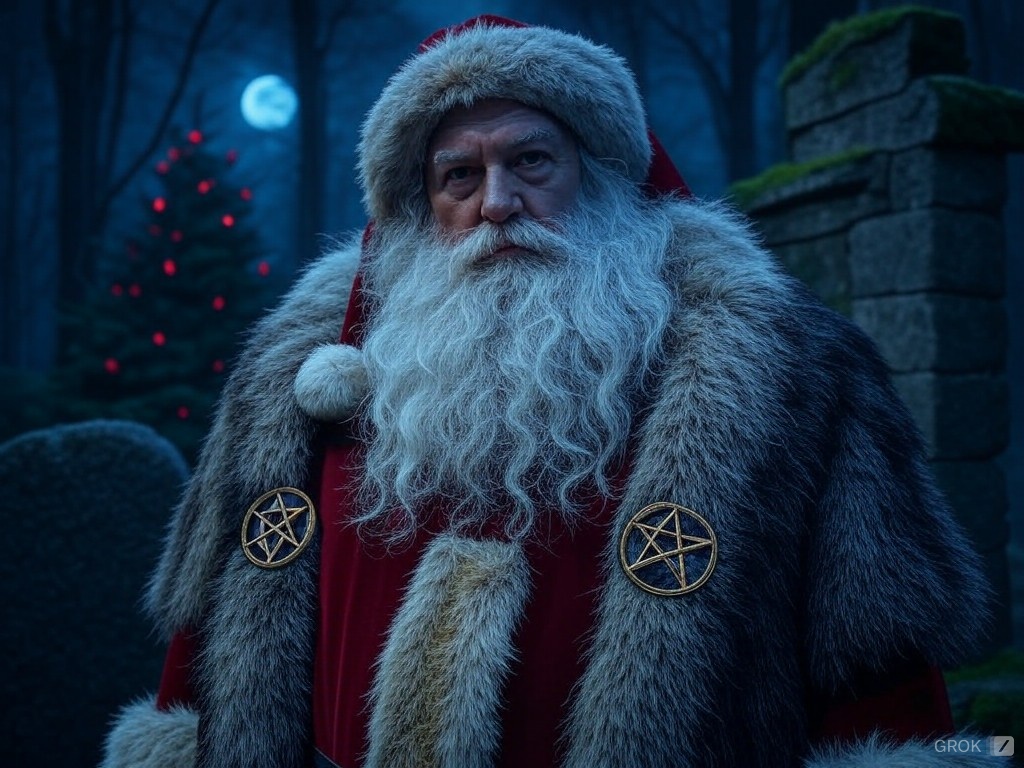
So lets look at how this Christmas event using Santa Clause mocks God. On the left is how people talk about Santa, on the right is what the Bible says about God. Look these verses up to compare.
Talking about Santa Talking about God___________
1. Has white hair like wool 1. Revelation 1:14 – Daniel 7:9
2. Beard-curly and white 2. Isaiah 50:6 – Rev. 1:14
3. Comes from North Pole 3. Ez. 1:4; Ex.26:35 Psa.48:2
4. Omniscient-knows about all 4. Revelation 19:6
5. Ageless, eternal 5. Rev. 1:8,21:6; Hebrews 13:8
6. Makes List of Judgments 6. Rev.20:12; 14:7; 21:27; 2 Cor.5:10
7. Checks list twice 7. Dan. 8:14; Matt. 10:26, 1 Cor.5:10
8. Gifts given on basis of a list 8. Matt.25:21; Rev. 21:27; 22:14
9. Christmas rewards once yearly 9. Leviticus 23:26-32
10. Confess wrongs to Santa 10. I John 2:1, I Tim. 2:5
11. Promise to be better next year 11. John 14:15,21; 15:10; I Jn. 2:3
12. Asks children to obey parents 12. Eph. 6:1; Prov. 6:20; Col. 3:20
13. Hour of his coming a mystery 13. Luke 12:40; Mark 13:33; Matt.24:36
14. Rudolph’s shining nose to guide 14. Matt. 2:2,7,9-10; Numbers 24:17
15. Calls all children to his knee 15. Matt. 19:14, Luke 18:16
16. Be good for goodness sake 16. Matt. 19:17; Col 1:29; Phil. 2:13
17. Has a twinkle in his eye 17. Rev. 1:14, 2:18
18. Swift visit to whole world in 1 day. 18. 2 Peter 3:8; Rev. 18:8, Isa. 47:9
19. Omnipresent-Found in every mall 19. Psa. 139:7-10; Eph. 4:6
20. Says “Ho,ho” 20. Zecheriah 2:6
See the similarities? How many of the 10 commandments are being broken here? James 2:10 says: “For whosoever shall keep the whole law, and yet offend in one point, he is guilty of all.”
If you want to see the video about Santa click here.
There are numerous reasons why children of God might choose not to celebrate Christmas. It appears that this pagan holiday was incorporated into Christianity by Rome as a means to blend pagan practices with Christian beliefs. This is reminiscent of how they altered the true Sabbath from Saturday to Sunday in 321 AD, seemingly to mock God and further integrate paganism with Christianity. There is so much more prove in detail about this holiday, to read more about it go to this link.
Beyond the aspects of paganism, consider the immense stress this holiday season can impose on individuals. The period is marked by greed, ingratitude, suffering, theft, fatalities, and trauma. While the prospect of receiving gifts, bonuses, and attending parties might temporarily boost people’s spirits, the joy is often fleeting. Once the gifts are unwrapped, life reverts to its usual routine, sometimes leaving people in a worse state than before.
Imagine the toll on those who work overtime, sacrificing sleep and proper nutrition to meet the holiday demands, or those who plunge into debt just to maintain appearances or to avoid disappointing someone with a modest gift. Think about those driven to crime, ending up in jail for theft, or the tragic cases where individuals take their own lives over financial despair, or even commit murder for the sake of acquiring something to give. All these scenarios are not just hypothetical; they’ve actually occurred during this season.
Consider this: how long does it really take to unwrap presents? Maybe just five minutes? Then it’s all over. All that stress and hardship for a mere five minutes of happiness, if the gift even brings joy. How disheartening is that?
Also, observe how during this holiday season, there’s always a push for toy drives to ensure children get presents. But why limit this generosity to just holidays? Why not have drives every day for necessities like clothes, shoes, and food, not just for kids but also for the homeless? Does their value only count during festive times?
For those who celebrate Christmas as Jesus’ birthday, what actions do you take to honor Him? Do you offer Him gifts in the form of a family Bible study, discussions about Jesus, or aiding others in finding faith in Him on that day? Or is your celebration similar to others, where the focus is on exchanging gifts around a Christmas tree? The only apparent nod to Jesus might be a nativity scene in your home or the traditional midnight mass. But is that truly celebrating Jesus? No, it seems more like the same gift-giving ritual everyone else engages in.
With the world’s events signaling the imminent return of Jesus, why are we not heeding the signs? Jesus warns in Matthew 16:3, “And in the morning, ‘It will be foul weather today: for the sky is red and lowering.’ O ye hypocrites, ye can discern the face of the sky; but can ye not discern the signs of the times?” The world seems to be spiraling into chaos, and even with a better leader in our country, biblical prophecies will still unfold. Rather than engaging in worldly pagan practices, let’s draw closer to God, becoming His obedient children to enjoy eternity in Paradise when that time arrives. Romans 12:2 advises, “And be not conformed to this world: but be ye transformed by the renewing of your mind, that ye may prove what is that good, and acceptable, and perfect, will of God.”
God is reaching out to everyone, but sadly, many are ignoring His call. Draw closer to God before it’s too late.
“For many are called, but few are chosen.” Matthew 22:14
“Many will say to me in that day, Lord, Lord, have we not prophesied in thy name? and in thy name have cast out devils? and in thy name done many wonderful works?And then will I profess unto them, I never knew you: depart from me, ye that work iniquity.” Matthew 7:22-24
Did you know Christmas used to be illegal? Click these links to learn more:
Works Cited:
Is christmas christian or pagan? (n.d.). https://remnantofgod.org/xmas.htm
King James Bible. (1992). . Project Gutenberg.
Occult criminal investigation. (n.d.). https://www.gvsu.edu/cms4/asset/903124DF-BD7F-3286-FE3330AA44F994DE/occult_criminal_investigation_2.pdf
Researchsupportsthetruth, & Researchsupportsthetruth. (2013a, July 2). December 25th – the birth of a “sun-god.” Christmas. https://christmaspagandeception.wordpress.com/2013/07/02/december-25th-the-birth-of-a-sun-god/
Researchsupportsthetruth, & Researchsupportsthetruth. (2013b, July 8). Celebrating Christmas is breaking the 1st commandment!. Christmas. https://christmaspagandeception.wordpress.com/2013/07/08/celebrating-christmas-is-breaking-the-1st-commandment/
Researchsupportsthetruth, & Researchsupportsthetruth. (2013c, July 8). Christ was not born in December!. Christmas. https://christmaspagandeception.wordpress.com/2013/07/08/christ-was-not-born-in-december/
Thornton, C. (2023, December 22). Why do we have christmas trees? the surprising origin of 5 popular holiday traditions. USA Today. https://www.usatoday.com/story/news/nation/2023/12/21/christmas-traditions-pagan-roots/71943013007/
Wallace, ByJ. W. (2019, March 26). Was jesus born on Christmas Day?. Cold Case Christianity. https://coldcasechristianity.com/writings/was-jesus-born-on-christmas-day/





 Obedient Lifestyle
Leave a comment